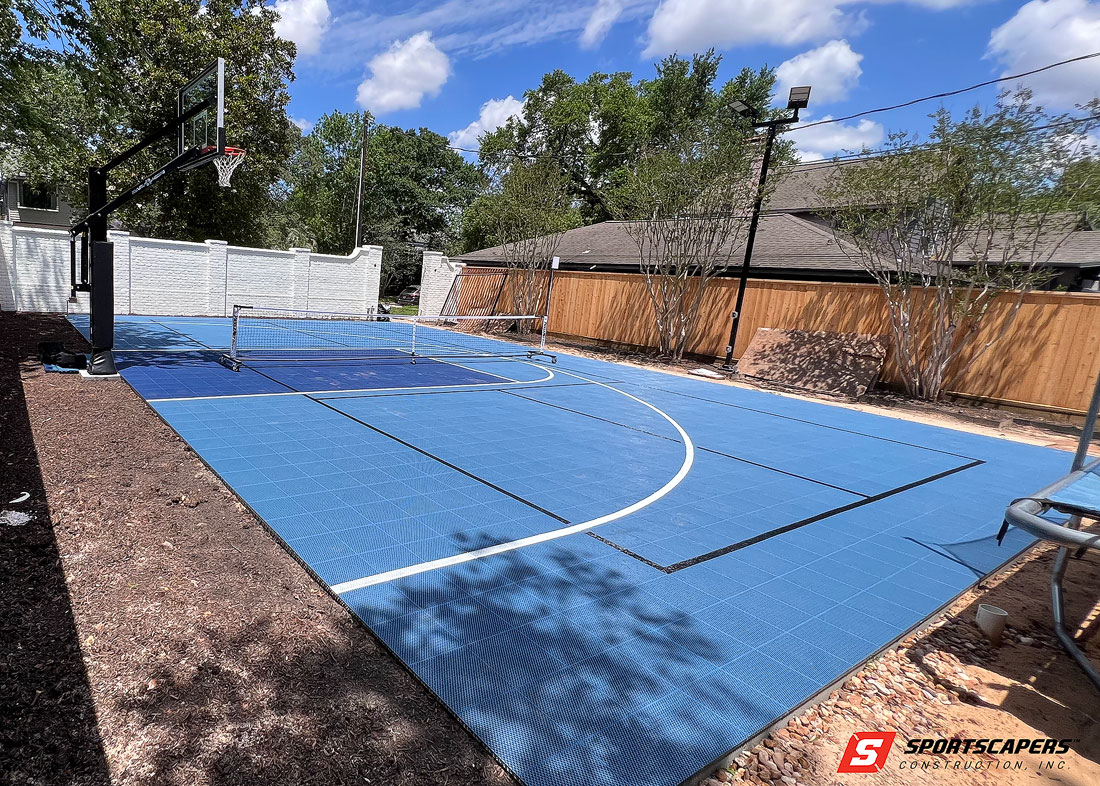

Soil, Drainage, and HOAs: What to Know Before Breaking Ground on Your Court
When you close your eyes and imagine a new backyard court, you probably see the "fun stuff." You’re thinking about the crisp snap of a pickleball serve, the satisfying swish of a late-night jump shot under LED lights, or the kids finally putting down their phones to get outside.
At Sportscapers Construction, we love those moments too. We’ve been building them across Houston since 1997. But as a turnkey builder that has survived nearly three decades in the Texas heat, we know a secret: the difference between a court that lasts 25 years and one that cracks in 24 months has nothing to do with the color of the tile or the height of the hoop.
It has everything to do with the "boring" stuff. We’re talking about expansive clay, drainage gradients, and the meticulous red tape of local HOAs.
If you’re planning a backyard sanctuary in Houston, Katy, or The Woodlands, here is the technical reality of what happens before the first bucket of concrete is poured.
The Houston "Gumbo" Challenge: Engineering for Expansive Soil
Houston soil is notorious in the construction world. We live on a massive bed of expansive clay, often affectionately (or frustratingly) called "gumbo."
When it rains, and in Houston, it pours, this clay absorbs water and expands like a sponge. When the summer heat hits and the ground dries out, the soil shrinks and pulls away. This constant "heaving" is the primary reason why amateur-built driveways and cheap backyard courts develop massive structural cracks within just a few seasons.
At Sportscapers, we don't just pour a sidewalk-grade slab and hope for the best. We treat every residential multi-sport court like a high-performance foundation. This involves:
- Subgrade Preparation: We don't just clear the grass. We stabilize the soil to ensure a consistent base.
- Engineering Specs: Whether it’s a modular tile court or an acrylic-surfaced tennis court, the concrete must be engineered to withstand the specific PSI requirements of the sport while resisting the movement of the clay beneath it.
- Vapor Barriers and Reinforcement: We use professional-grade rebar and vapor barriers where necessary to prevent moisture from wicking up through the slab, which can cause surface delamination over time.
Investing $25,000 to $120,000 in a backyard athletic facility is a major commitment. You deserve a slab that is over-engineered for the environment it sits in.

Drainage: Why Your Court Shouldn't Be an Island (or a Pond)
Houston is flat. Really flat. This means water doesn't just "go away" on its own. When you add a large, impermeable surface like a backyard court to your property, you are changing the way water moves across your entire lot.
If drainage isn't handled correctly, you run two major risks:
- Court Shifting: Standing water around the edges of a slab will accelerate soil expansion, leading to unlevel play and eventual cracking.
- Neighbor Issues: If your new court sends a river of runoff into your neighbor’s flowerbeds or, heaven forbid, their living room, you’re looking at a legal and social nightmare.
At Sportscapers, we take a holistic approach to the backyard sanctuary. We don't just look at the court footprint; we look at the flow of the entire landscape. We integrate area drains, French drains, and strategic grading to ensure that water is whisked away from the court and directed toward the appropriate city or neighborhood storm systems.
Navigating the HOA: From The Woodlands to Sugar Land
In high-end Houston communities, the Homeowners Association (HOA) is often the most significant hurdle. If you live in The Woodlands, you know that tree preservation and setback requirements are non-negotiable. If you’re in Katy or Fulshear, you might face strict "impermeable surface" ratios that limit how much of your yard can be covered by a court or pool.
Trying to handle an HOA application on your own can feel like a part-time job. This is where Sportscapers’ 29 years of experience pays off. We speak the language of the architectural review boards. We provide the 3D renderings and technical site plans they need to see to say "yes."
We understand the nuances:
- Setbacks: How close can the fencing get to the property line?
- Lighting: How do we aim those directional LED sports lights so your kids can train after dark without bothering the house next door?
- Aesthetics: Does the court color palette blend with the community standards?
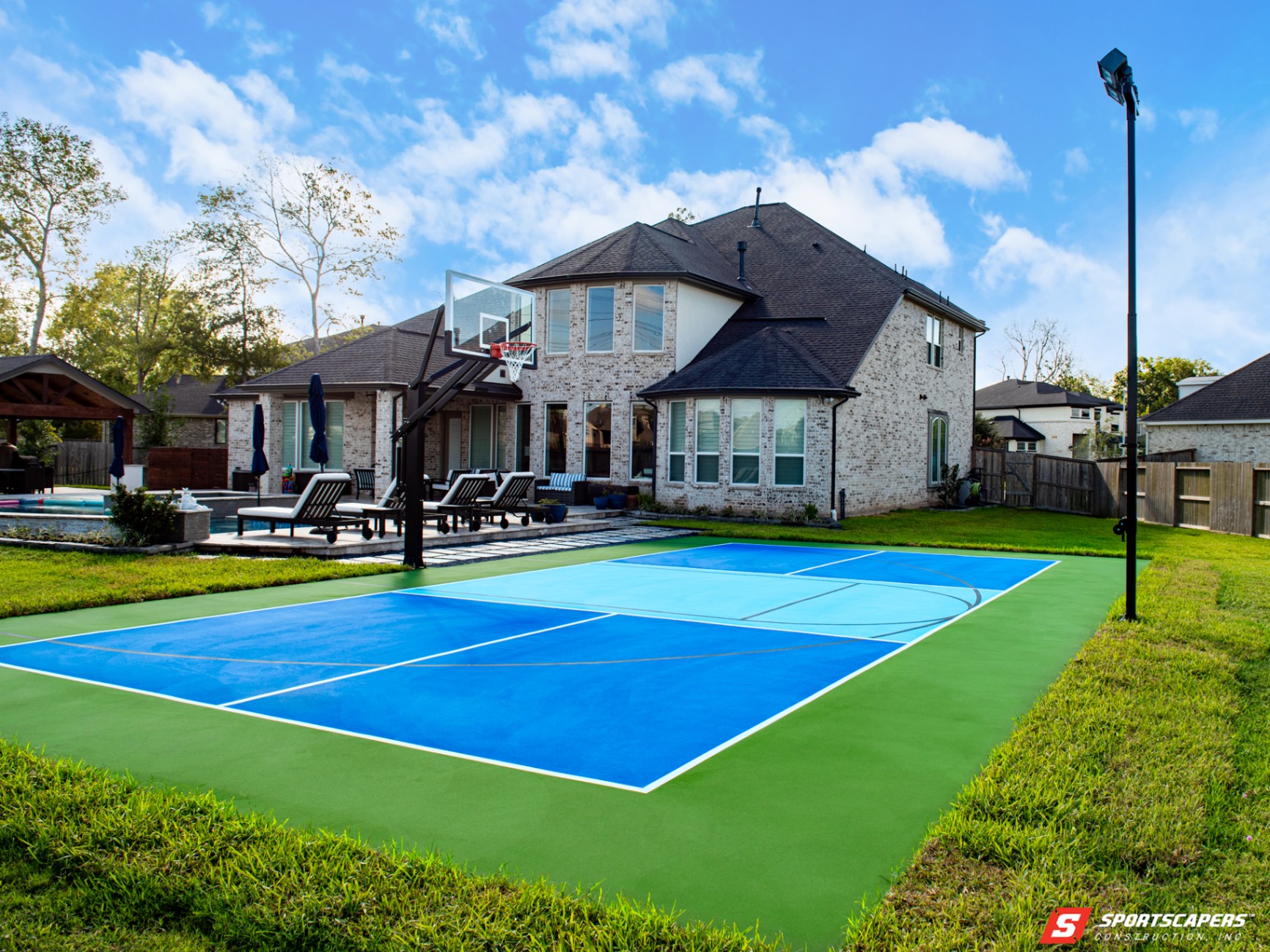
The Sportscapers 'ABC Model': Your Turnkey Advantage
Most homeowners think they need to hire an architect, then find a concrete guy, then find a fence company, and then find someone to install the sports surface. This is a recipe for finger-pointing when something goes wrong.
We pioneered the ABC Model to eliminate that stress:
- A – Architect: We handle the professional design and high-end visualization. For clients committed to a construction project, we provide 3D renderings that show exactly how the court, landscaping, and lighting will look. (Design-only services are available for $2,500–$5,000 for those not yet ready to break ground).
- B – Builder: We are the general contractor. From the first tractor on-site to the final stripe on the court, we own the process. We manage the soil stabilization, the drainage engineering, and the heavy equipment.
- C – Consultant: We act as your advocate. Whether it’s navigating a difficult HOA, advising on the best north-south orientation to keep the sun out of a batter's eyes in a batting cage, or choosing between modular tiles and acrylic surfaces, we provide the expert guidance you need to maximize your ROI.
Why Technical Excellence Drives Family Value
Why do we obsess over soil and drainage? Because we want your investment to be a legacy. We’ve built facilities for the likes of Baseball USA and the Cotton Sports Complex, and we bring that same "pro-grade" engineering to your backyard.
When we build a residential batting cage, for example: typically in the $18,000 to $26,000 range: we use 4-inch powder-coated poles and #42 gauge UV-dipped netting. We include a turf base that is playable immediately after a Houston rainstorm with zero maintenance. We build it so your 10-year-old can use it every day until they head off to a college program.

Frequently Asked Questions
Q: Do I really need an engineered slab for a backyard court?
A: In Houston? Yes. Without proper reinforcement and soil stabilization, the clay will move your slab, leading to "dead spots" in the ball bounce and structural cracks that are expensive to repair.
Q: How long does the HOA process usually take?
A: It varies by neighborhood, but typically 30 to 60 days. Because we provide professional 3D renderings and technical plans, we often see faster approvals because the boards have all the information they need upfront.
Q: Can you build a court over existing drainage lines?
A: We rarely recommend it. Part of our site prep involves locating and potentially rerouting existing utilities or drainage to ensure that the court foundation is never compromised by a leaking pipe or shifting line.
Q: Is north-south orientation really that important?
A: Absolutely. It is the professional standard. By aligning your court (especially for tennis or batting cages) north-to-south, you ensure that the sun is never directly in the eyes of the players during peak morning or afternoon hours. It’s a small detail that amateurs miss, but pros never do.
Ready to Build Your Sanctuary?
If you’re ready to stop dreaming and start building, don't settle for a "concrete guy" with a truck and a shovel. Choose the team that has been engineering Houston’s finest athletic facilities since 1997.
From the initial 3D visualization to the final turnkey delivery, Sportscapers Construction handles the soil, the drainage, the HOAs, and everything in between. We build the "boring" stuff better than anyone else, so you can focus on the fun stuff.
Start your transformation today.
Contact: sales.sportscapers@gmail.com
Website: www.sportscapers.com
Serving Houston, The Woodlands, Katy, Sugar Land, and surrounding areas.