
Building Multi-Sport Courts in Sugar Land: Drainage, Soil, and Site Prep Considerations
Sugar Land is a community built on a legacy of excellence, from the master-planned beauty of First Colony to the sprawling estates of Riverstone and Sweetwater. But if you’ve lived here through a single Texas summer or a sudden Gulf Coast downpour, you know that the ground beneath our feet isn't always as cooperative as we'd like.
When you decide to level up your backyard with a custom multi-sport court, the flashiest part is choosing the colors and the hoops. However, in Sugar Land, the real victory is won in the dirt. At Sportscapers Construction, Inc., we’ve been building across the Houston area since 1997, and we’ve seen what happens when builders ignore the local "gumbo" soil and the unique drainage requirements of Fort Bend County.
If you want a court that stays level, drains instantly, and lasts until your kids are coaching their own kids, you have to prioritize engineering over aesthetics, at least at the start.
The Sugar Land "Gumbo" Challenge: Why Soil Matters
In the construction world, Sugar Land soil is famous, and not for a good reason. We often deal with "black gumbo", a heavy, expansive clay that acts like a sponge. When it rains, it swells. When we hit a July drought, it shrinks and cracks.
If you pour a standard concrete slab for a backyard court without accounting for this movement, your court will eventually resemble the surface of the moon. Cracks, heaving, and "dead spots" in your basketball bounce are almost always a result of poor soil preparation.
At Sportscapers, we treat every residential project like a pro-level facility. We don't just "scrape and pour." We analyze the soil density and ensure the sub-base is engineered to handle the specific volatility of your Sugar Land lot. This often involves a rigorous excavation process and the introduction of stable base materials that provide a buffer between the restless clay and your finished playing surface.
Engineering: The Invisible MVP of Your Backyard
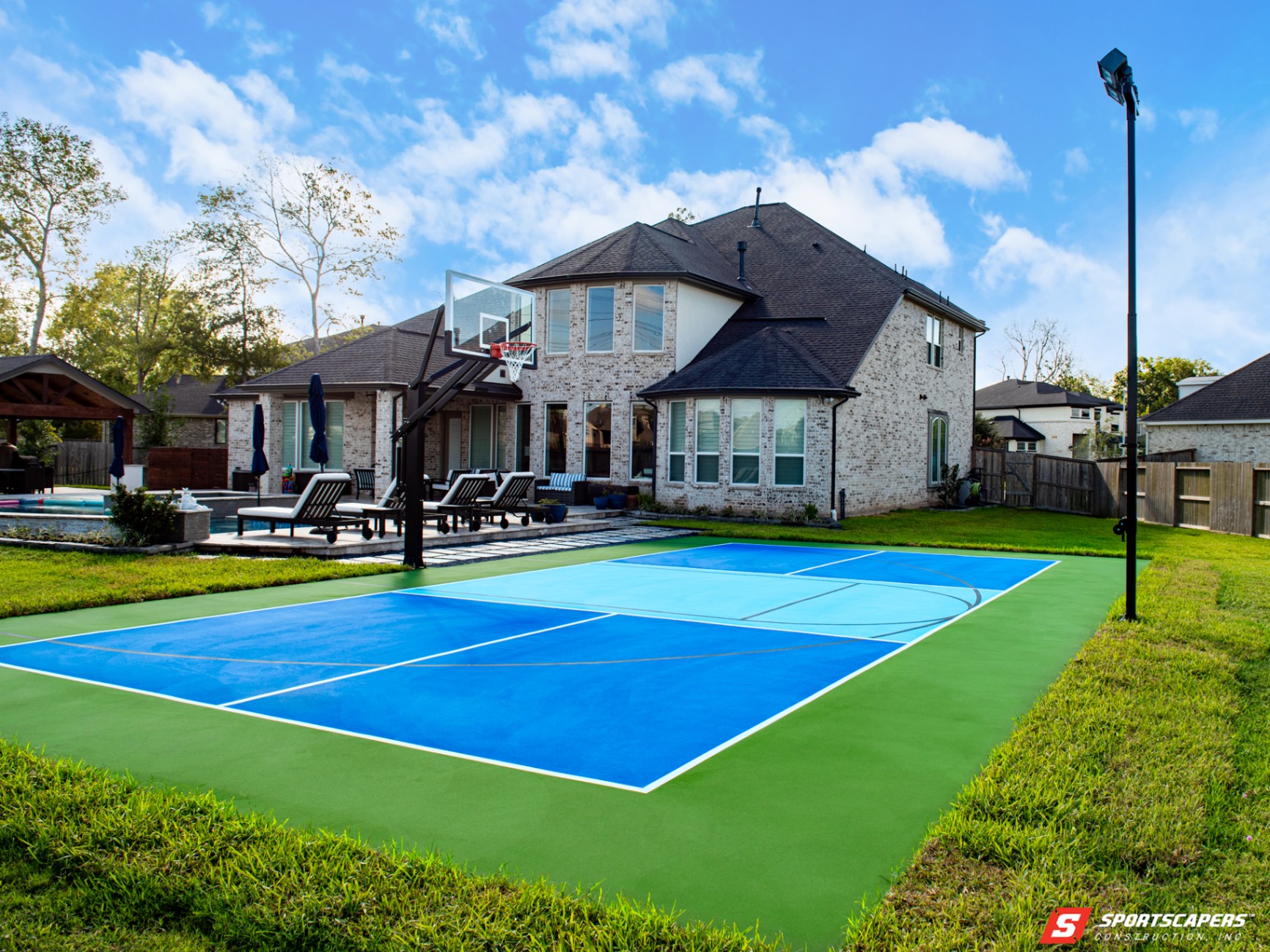
Why does a Sportscapers court look and play better ten years down the road? Because we view engineering as the MVP of the build. Most homeowners think of a backyard court as a weekend DIY project or something a general landscaper can handle. But there is a massive difference between a patio and a high-performance athletic court.
A multi-sport court requires a "Plan of Attack" that covers:
- Laser Grading: Ensuring the site is perfectly pitched to move water without creating a slope that affects your free throw.
- Slab Specification: We don't use "driveway specs." Our slabs are reinforced and poured to withstand the specific lateral and vertical forces of athletic play.
- Vapor Barriers and Reinforcement: Protecting the concrete from moisture coming up through the soil, which can cause de-lamination of acrylic coatings or modular tile issues over time.
When you invest between $25,000 and $120,000 in a residential backyard sanctuary, you aren't just buying a place to play; you're buying a piece of engineered infrastructure.
Drainage: Keeping the Game Moving After the Storm
In Sugar Land, "when it rains, it pours" isn't a metaphor, it’s the forecast. A backyard court is a large, non-porous surface. If you don’t have a professional drainage plan, that water is going to end up in your pool, your neighbor's yard, or worse, your foundation.
We engineer professional drainage systems that meet city codes and protect your property from erosion. This might include:
- Surface Drains: Catch basins strategically placed to whisk water away.
- French Drains: Sub-surface solutions to manage groundwater and soil saturation.
- Swales and Grading: Using the natural topography of your yard to direct runoff toward existing drainage easements.
A properly engineered court should be playable within minutes of the rain stopping. If you’re seeing puddles (known in the industry as "birdbaths") lingering on your court, the site prep failed.
Site Prep: The Foundation of the Sportscapers Standard
One of the common mistakes we see in Sugar Land is the "orientation error." If you’re building a backyard court that includes basketball or a batting cage, you have to consider the sun. We follow the professional standard of North-South orientation whenever the lot allows. This minimizes sun glare for shooters and ensures that if you’re building a residential batting cage, the batter isn’t staring directly into a 5:00 PM Texas sunset.
Our turnkey process means we handle everything from the initial 3D rendering to the final coat of paint. For clients committed to a construction project, we provide high-end visualization as a signature service. This allows you to see how the court, the LED lighting, and the landscaping flow together as a cohesive sanctuary. We aren't just equipment installers; we are consultants on the full landscape.
What about the "Legacy" Factor?
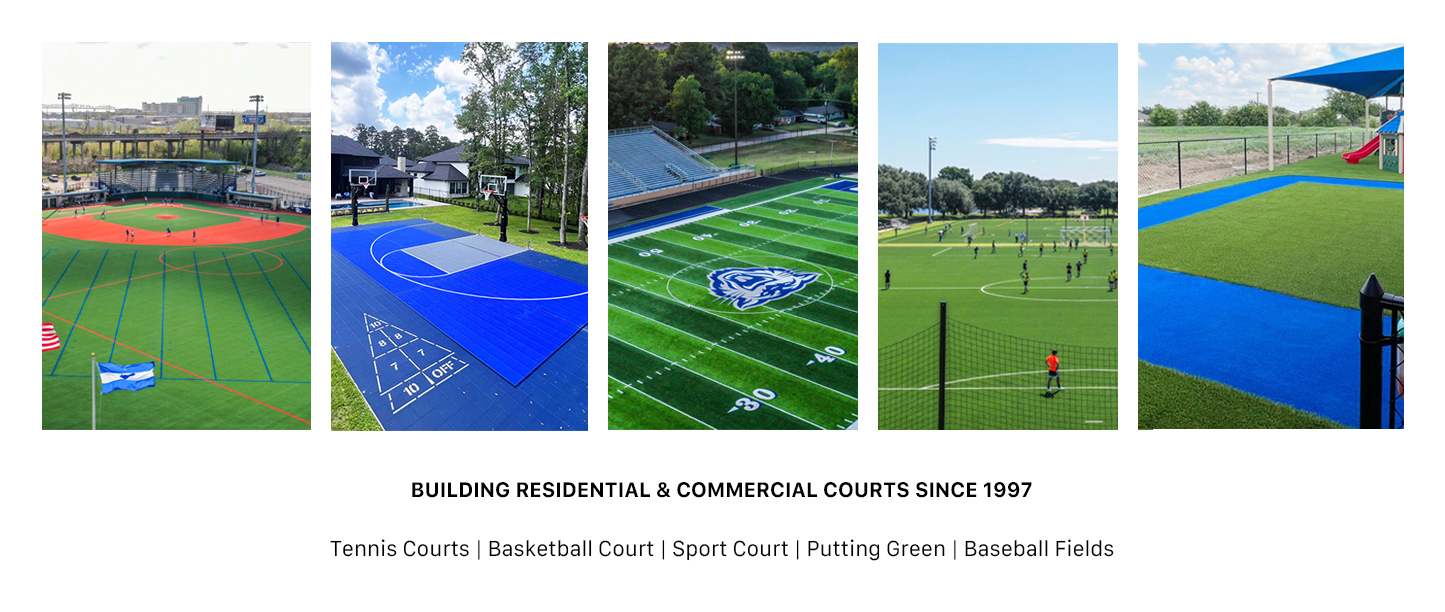
We’ve built for organizations like Baseball USA and the Cotton Sports Complex. We’ve worked with Cy-Hope and Larry Dierker, and built the turf fields for Livingston ISD. When we bring that same level of "Big League" engineering to your Sugar Land backyard, we’re using the same specs that pro athletes trust. We "over-engineer" your backyard court because we know that residential use is often more frequent and demanding than people realize.
Frequently Asked Questions for Sugar Land Homeowners
Q: Can I build a court on a lot with a lot of trees like those in older parts of Sugar Land?
A: Absolutely. While we might have to navigate root systems and forested lots (much like we do in The Woodlands), our 3D design phase helps us visualize the footprint to minimize impact on mature trees while ensuring the court stays level.
Q: Do I need a permit for a backyard court in Sugar Land?
A: Yes, most of the time. Sugar Land and Fort Bend County have specific rules regarding "impermeable cover." Because we are a turnkey builder, we handle the permitting and HOA communications for you. We know the codes, and we know how to design a drainage plan that gets approved.
Q: How much does a project like this typically cost?
A: For a high-quality, professionally engineered residential court, you can expect an investment range of $25,000 to $120,000. This varies based on the size, the complexity of the site prep (drainage and soil issues), and the amenities like directional LED lighting and fencing.
Q: Why shouldn't I just hire a local concrete guy?
A: A concrete contractor knows how to pour a flat slab. They don't necessarily know how to build an athletic facility. They often miss the nuances of sports-specific grading, North-South orientation, and the high-strength reinforcement needed for multi-sport play. Sportscapers has been doing this since 1997: we live and breathe sports construction.
The Finished Product: More Than Just Concrete
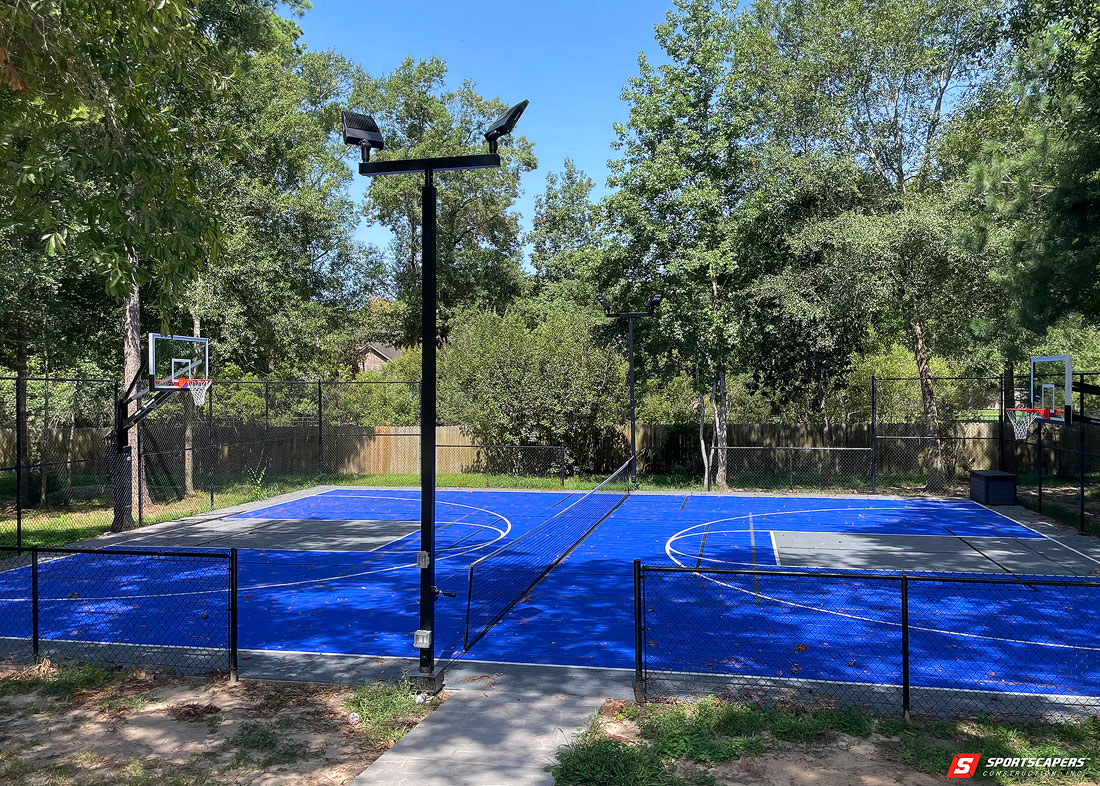
When the soil is stabilized, the drainage is flowing, and the concrete is cured, that’s when the fun begins. Whether you choose a modular tile court for its joint-saving "lateral forgiveness" or a classic acrylic tennis surface, the result is a backyard destination.
By integrating features like directional LED sports lights, you extend the playability of your court into the fall and winter months. These lights are a highly recommended add-on because they keep the illumination focused on the game and off your neighbor's patio, which is crucial for the tight-knit luxury communities in Sugar Land.
If you’re looking to add a residential batting cage, remember that we offer a specialized turnkey package ranging from $18,000 to $26,000. This includes a turf base that stays playable after rain with zero maintenance, 4-inch powder-coated poles, and hurricane-rated #42 gauge UV-dipped netting. It’s built to last from your child’s first T-ball swing all the way through their college training.
Get Started on Your Sugar Land Sanctuary
Don't leave your backyard investment to chance. In a region where the soil is always moving and the rain is always coming, you need a builder who understands the local geography as well as they understand the game.
At Sportscapers Construction, Inc., we pride ourselves on being a turnkey solution. From the first 3D rendering to the final buzzer, we manage the engineering, the construction, and the finishing touches.
Ready to see what's possible for your Sugar Land home? Let’s talk about the specs, the soil, and the future of your backyard.
Contact us today at:
sales.sportscapers@gmail.com